
Annotate: produce what the record has to carry.
The open-ended step, and the one that differs most between projects. Whatever your library asks for, this is where it gets built, computed or derived.
The first step transforms the data you have into the data you need.
It is done by combining the tools Bionamic ships with. A representative selection is below, not the full list. A workflow uses the few it needs, in whatever order the project calls for.
Structure prediction and modelling
- Boltz-2
- Chai-1
- ABodyBuilder2
- NanoBodyBuilder2
- TCRBuilder2
Complexes with protein, ligand, DNA and RNA; antibody Fv from VH and VL, nanobodies and TCRs, with per-residue predicted error.
Design and mutation scanning
- RFdiffusion
- RFantibody
- ProteinMPNN
- ProteinMPNN-ddG
- AntiFold
- ESM-IF1
- ThermoMPNN
De novo backbones against a chosen antigen and epitope, sequence design on a fixed backbone, and exhaustive point-mutation scans for fitness and ΔΔG.
Developability and biophysics
- Antibody profiling
- Therapeutic nanobody profiler
- DeepSP
- DeepViscosity
- Aggrescan3D
- NetSolP
- MusiteDeep
- SEMA-3D
Aggregation, viscosity, solubility, phosphorylation sites and conformational B-cell epitopes.
Humanness and immunogenicity
- BioPhi
- OASis
- Sapiens
- MHCflurry
- MHCfovea
- MixMHC2pred
- TLimmuno2
- DeepImmuno
Humanness scoring and humanisation, MHC-I and MHC-II binding, and immunogenicity prediction.
Language models and small molecules
- AMPLIFY
- ADMET-AI
- GNINA
Protein language model likelihoods and embeddings, 49 ADMET endpoints from SMILES, and docking with CNN pose and affinity rescoring.
Sequence search and alignment
- BLAST
- HMMER
- MMseqs2
- DIAMOND
- CD-HIT
- Clustal Omega
- seqkit
Numbering and germlines
- ANARCI
- IgBLAST
- IMGT germline search
IMGT, Kabat, Chothia, Martin and Aho, plus a fast in-house numbering tool.
Repertoires and NGS
- OAS paired and unpaired
- SAbDab
- FASTQ to HMM counting
- Library mapping
- Sanger AB1
Display-library counting with pre and post selection, closest-member matching and profile HMM building.
Docking, structure and surfaces
- AutoDock Vina
- GNINA
- LightDock
- US-align
- Foldseek
- PyMOL
- SASA
Including a prebuilt antibody structure database and surface property mapping.
Simulation and cheminformatics
- GROMACS
- OpenMM
- APBS
- PDB2PQR
- PROPKA
- RDKit
- ProtParam
- Codon optimisation
Molecular dynamics on GPU, electrostatics, descriptors and properties from SMILES.
The antibody walkthrough below uses a handful of these. Another project might assemble a multi-chain molecule, construct an expression vector, derive batch information or call a model of your own. The two steps that follow do not change when this one does, because they read the library rather than the tool.
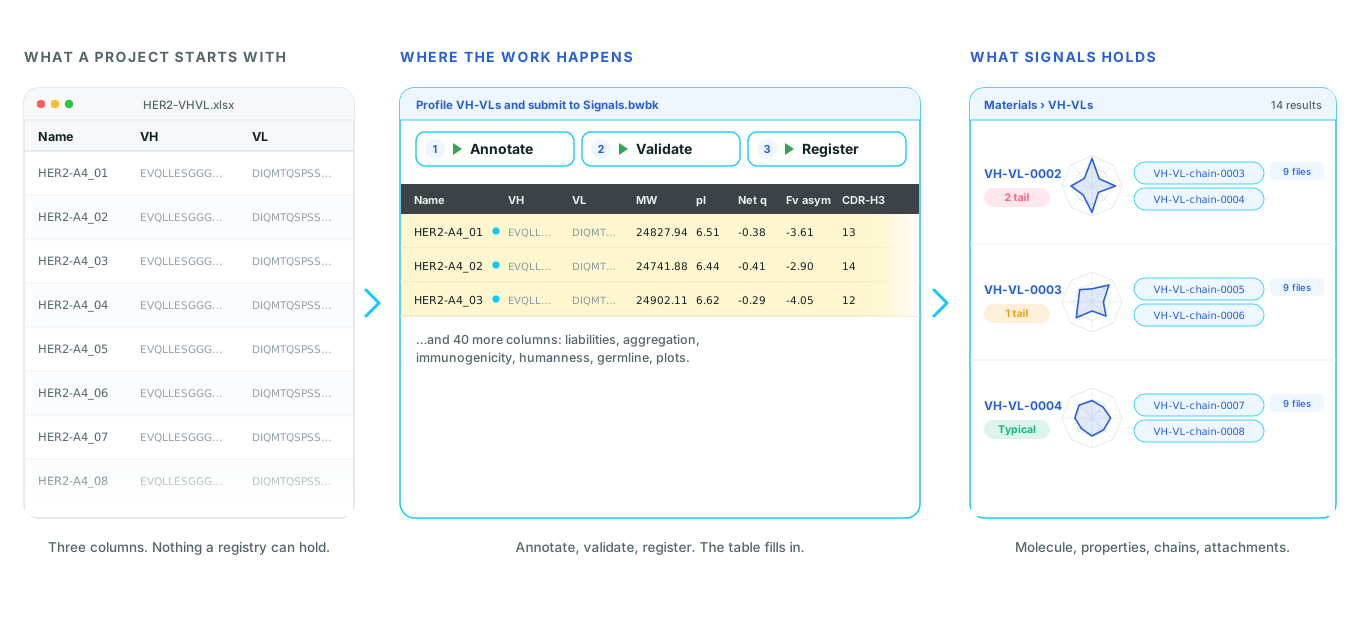
From pasted sequences to a profiled table.
VH and VL sequences, pasted straight from Excel. Sequences also come in from FASTA and GenBank files, and from ABI trace files off the sequencer, so a project can start from whatever its data already is.
Selected rows are then folded and run through the developability, immunogenicity and humanness tools. The molecule is built with its CDR and liability features, and the computed properties land back in the same table, in columns named for the Signals fields they will fill. That naming is what lets the next two steps work against the library rather than against a mapping table.