
Bionamic workspace
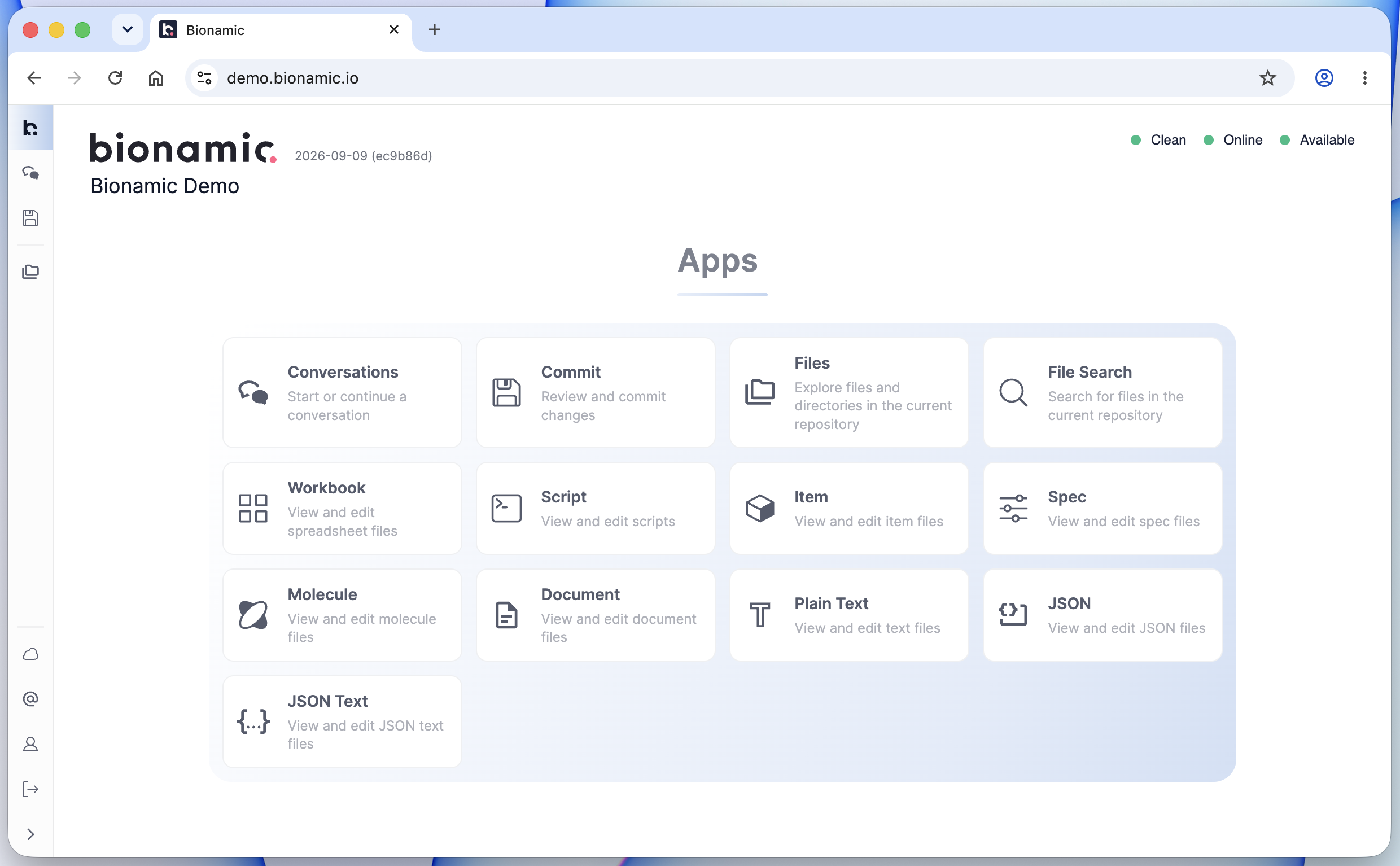
Bionamic is a web application bringing data and AI agents together across a broad range of use cases, with scientific tools specialized for antibody and biologics discovery.
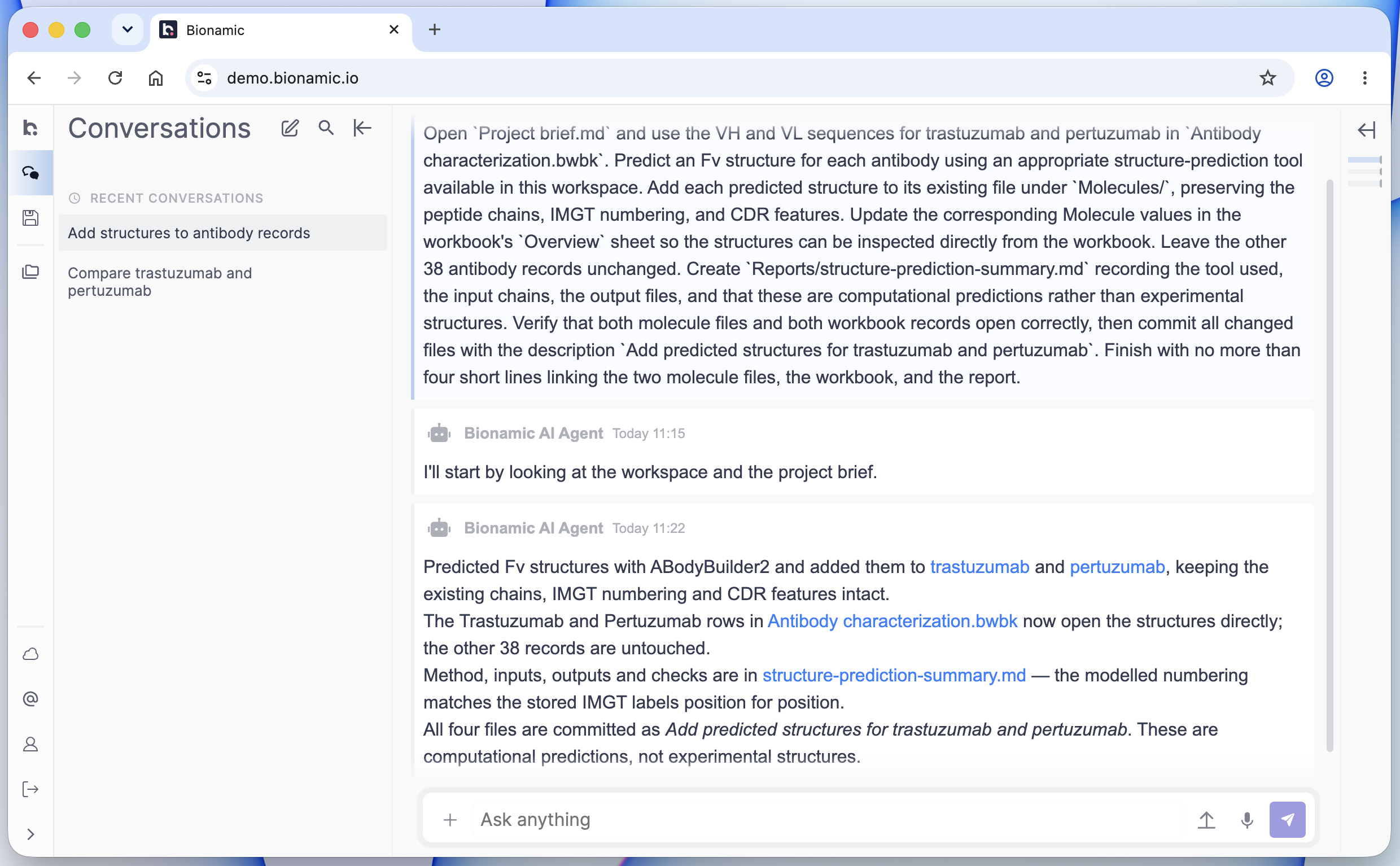
Agents and conversations
Multiple researchers and agents can participate in the same conversation to discuss the science. Agents can run computations and create or modify files and spreadsheets directly from the conversation. The Bionamic support team can optionally join when help is needed.
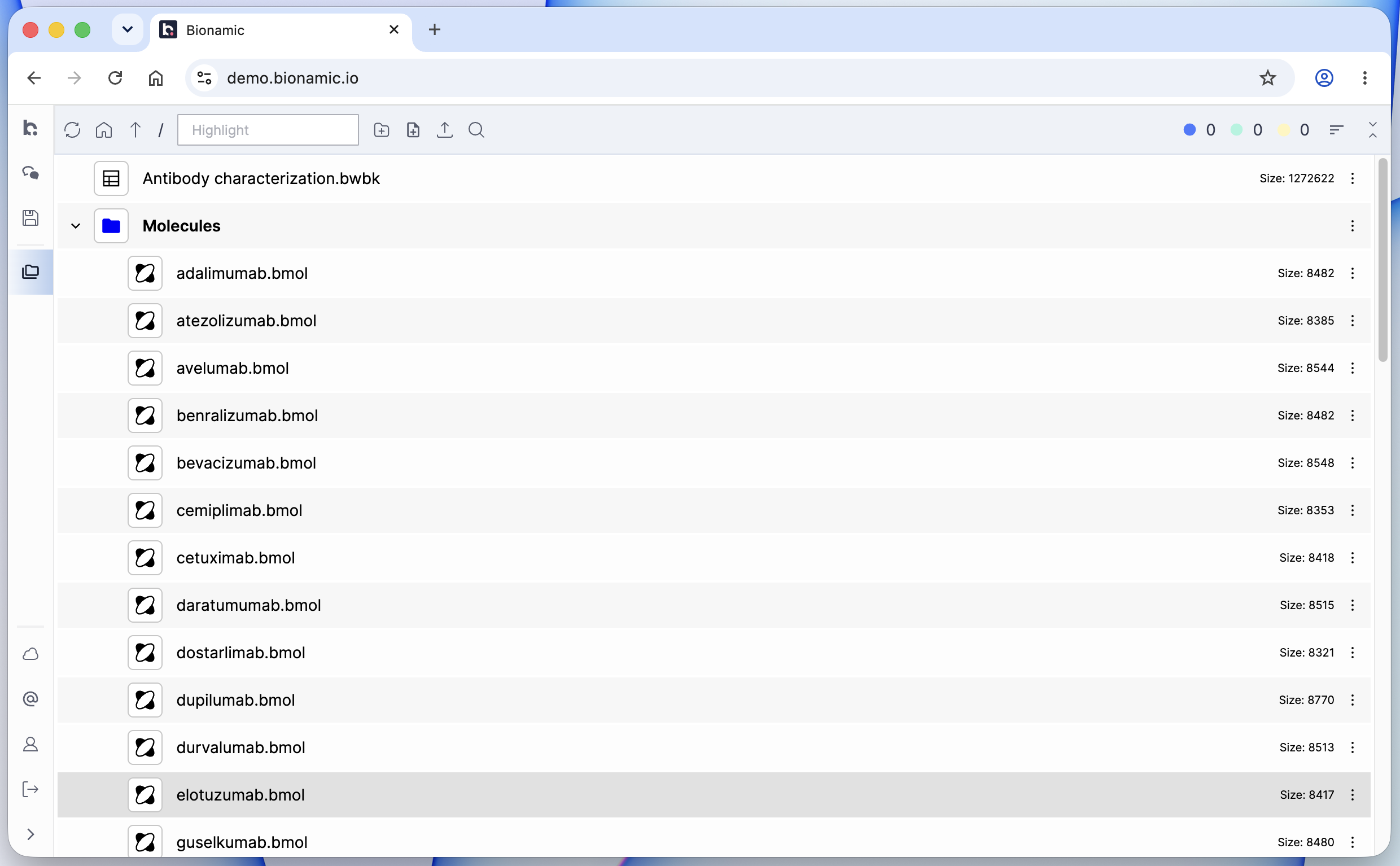
App file system
Browse and search the files and directories in your workspace, then open spreadsheets in the workbook and other files in their corresponding apps.
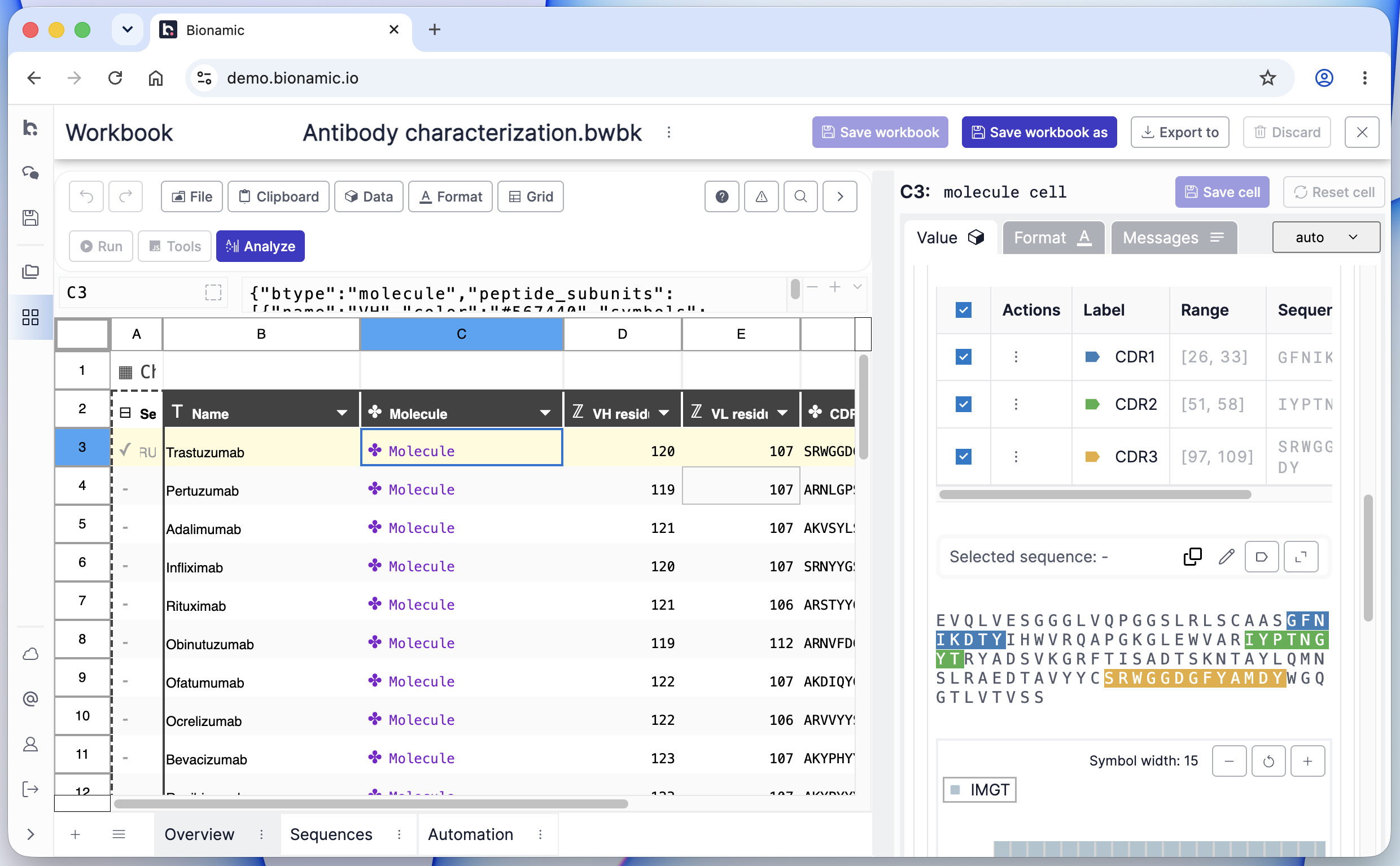
Workbooks
Paste data from Excel or import files such as FASTA. Work with sequences, molecule records, annotations, and calculated properties directly in the spreadsheet.
Molecule files
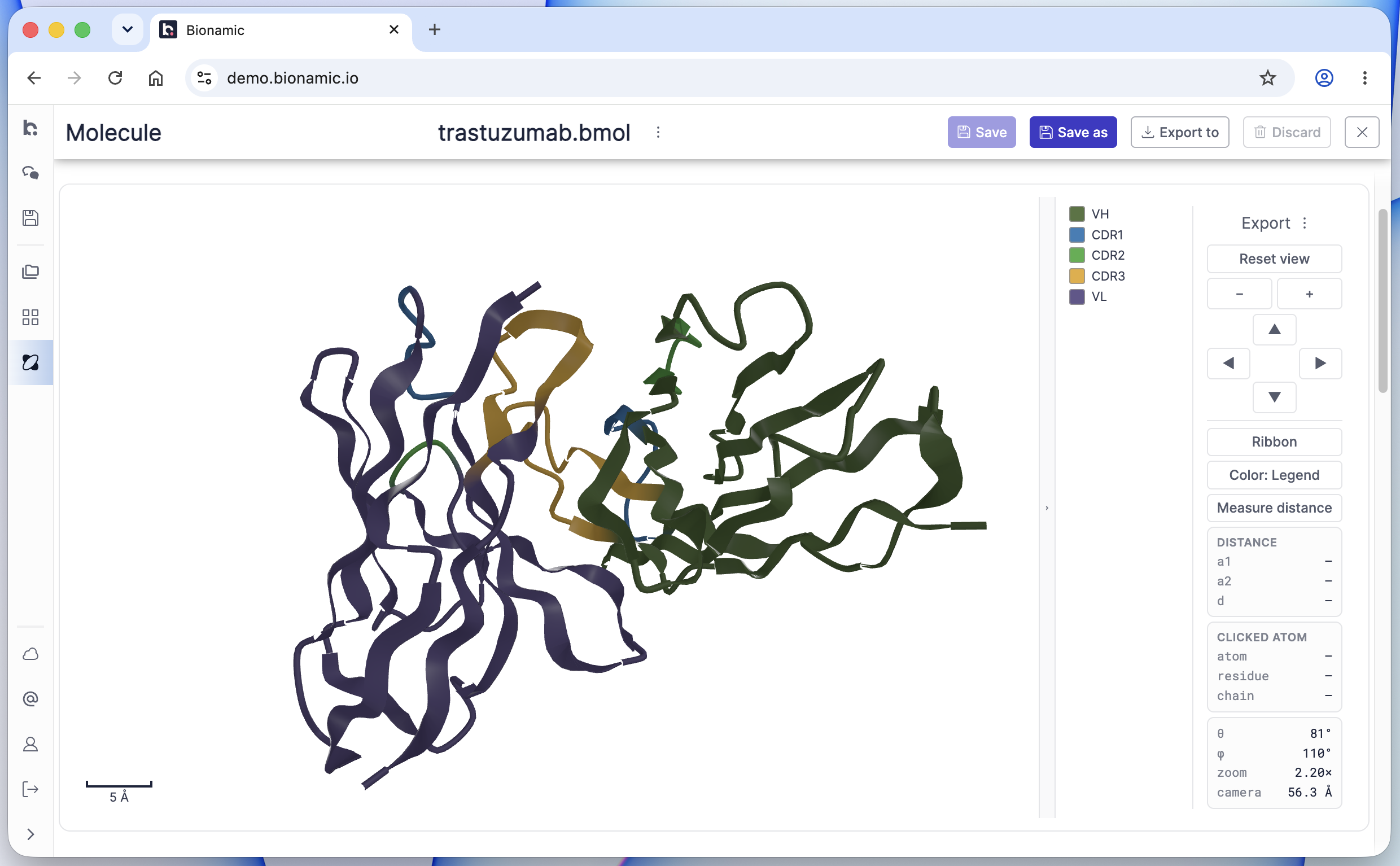
Molecule files bring together peptide chains, sequence annotations, and 3D structures. Open a file in the Molecule app to inspect the structure alongside its sequences and annotated features, such as antibody CDRs.
Bioinformatics tools
Run scientific analyses with the tools and reference databases listed below. More tools, including custom tools, are easy to install.
View all 66 scientific tools and reference resources
| Tool / resource | Purpose |
|---|---|
| Antibody analysis and design | |
| Bionamic Antibody Profiling | Antibody profiling and developability ranking in workbooks. |
| ANARCI | Antibody numbering and receptor classification. |
| BioPhi / Sapiens | Antibody humanization and humanness assessment. |
| IgBLAST | Immunoglobulin and T-cell receptor sequence analysis. |
| Therapeutic Nanobody Profiler | Nanobody structure and developability profiling. |
| AntiFold | Antibody sequence design from structure. |
| RFantibody / RFdiffusion / ProteinMPNN | Antibody backbone and sequence design. |
| Codon optimization (DNA Chisel) | Optimize DNA sequences for expression. |
| Sequences and sequencing data | |
| Sequence alignment | Multiple-sequence alignment and annotated alignment figures. |
| Clustal Omega | Multiple-sequence alignment. |
| HMMER | Sequence search and alignment with profile hidden Markov models. |
| HMM build | Build profile models from sequences or alignments. |
| BLAST | Sequence similarity search. |
| DIAMOND | Fast protein sequence alignment and search. |
| MMseqs2 | Sequence search and clustering. |
| CD-HIT | Sequence clustering and redundancy reduction. |
| SeqKit | FASTA and FASTQ processing. |
| AMPLIFY | Protein language-model analysis. |
| NGS library mapping | Map sequencing reads to reference libraries and count variants. |
| FASTQ HMM counts | Extract and count sequences using profile models. |
| FASTQ protein-framework counts | Assign reads probabilistically across protein-framework libraries. |
| FASTQ counts search | Search aggregated count tables for matching sequences. |
| ABI / AB1 reader | Read Sanger sequences and chromatogram traces. |
| Structure prediction, analysis, and simulation | |
| ImmuneBuilder | Antibody, nanobody, and T-cell receptor structure prediction. |
| Boltz-2 | Structure and binding-affinity prediction. |
| Chai-1 | Molecular structure prediction. |
| OpenDDE | All-atom co-folding prediction. |
| Foldseek | Structure search and clustering. |
| US-align | Structural alignment and similarity measurement. |
| Relative SASA | Per-residue solvent accessibility. |
| SURFMAP | Two-dimensional maps of protein surface properties. |
| Surface UMAP | Embed surface properties for comparison and clustering. |
| APBS | Biomolecular electrostatics calculations. |
| PDB2PQR | Prepare structures with atomic charges and radii. |
| PROPKA | Predict protein residue pKa values. |
| PyMOL | Molecular visualization and structure figures. |
| GROMACS | Molecular dynamics simulation. |
| OpenMM / ProtParam | Structure minimization and protein physicochemical properties. |
| Developability and mutation effects | |
| Aggrescan3D | Structure-based aggregation propensity. |
| NetSolP | Protein solubility and usability prediction. |
| DeepSP | Antibody surface and developability descriptors. |
| DeepViscosity | Antibody viscosity classification. |
| MusiteDeep | Phosphorylation-site prediction. |
| ThermoMPNN | Mutation effects on protein stability. |
| ProteinMPNN-ddG | Stability-change estimation for point mutations. |
| ESM-IF1 mutation scoring | Structure-conditioned mutation scoring. |
| Immunogenicity and epitopes | |
| DeepImmuno | Peptide immunogenicity prediction. |
| TLimmuno2 | Peptide/HLA T-cell immunogenicity prediction. |
| MHCflurry | MHC class I presentation prediction. |
| MHCfovea | MHC class I peptide-binding prediction. |
| MixMHC2pred | MHC class II peptide-binding prediction. |
| SEMA 2.0 | Structure-aware epitope prediction. |
| Docking, chemistry, and pharmacokinetics | |
| AutoDock Vina | Small-molecule docking. |
| GNINA | Small-molecule docking with neural-network scoring. |
| LightDock | Macromolecular docking. |
| ADMET-AI | Small-molecule ADMET property prediction. |
| RDKit / PiChemist | Molecular descriptors, SMILES conversion, and isoelectric-point prediction. |
| PKNCA | Pharmacokinetic non-compartmental analysis. |
| Reference databases | |
| IMGT/GENE-DB | Reference germline sequences and search indices. |
| OAS CDR3 | Search observed unpaired antibody CDR3 sequences. |
| OAS paired sequences | Search paired antibody sequence records. |
| SAbDab | Antibody structures with metadata and structural search. |
| UniProtKB/Swiss-Prot | Protein reference sequences for search and alignment generation. |
| Data analysis and extraction | |
| Random forest classifier | Classification, cross-validation, and feature importance. |
| PDF table extraction | Extract tabular data from PDF documents. |
| Biopython | Sequence and structure parsing and biological data analysis. |
Scripts
Describe a workflow and an agent can typically create a script to automate it. Scripts can run within workbooks or as standalone tasks, and saved workflows can be repeated with a single button click.
Integrations
Use Bionamic alongside existing ELNs, LIMS, CRO portals, and scientific tools. Bring data into the workspace for analysis and return records and results to the systems your team already uses. We tailor integrations using APIs, file exchange, and scripts. Check out the Revvity Signals integration as an example.
Hosting
We help deploy Bionamic on the infrastructure that suits your team.
AI options
Use your preferred AI provider or let us help set up a cloud provider or local agent.
Security
Passkeys
Phishing-resistant sign-in with your fingerprint, face recognition, or device PIN.
No stored passwords
Bionamic does not store passwords.
Agent sandboxes
Agents run inside sandboxes with process isolation enforced by the Linux kernel, restricting their access to the surrounding system.
IP restrictions
Optionally restrict access to approved IP addresses or ranges.
Security and AI governance
See more details under Security and AI governance .
Team access
Bionamic sign-on
Sign in directly to Bionamic with a passkey.
Single Sign-On
Connect your organization’s sign-in system with SSO, available on demand.
Team administration
Admins can add or remove team members and set access rules on a dedicated admin page.