
Annotate: turn the data you have into the data you need.
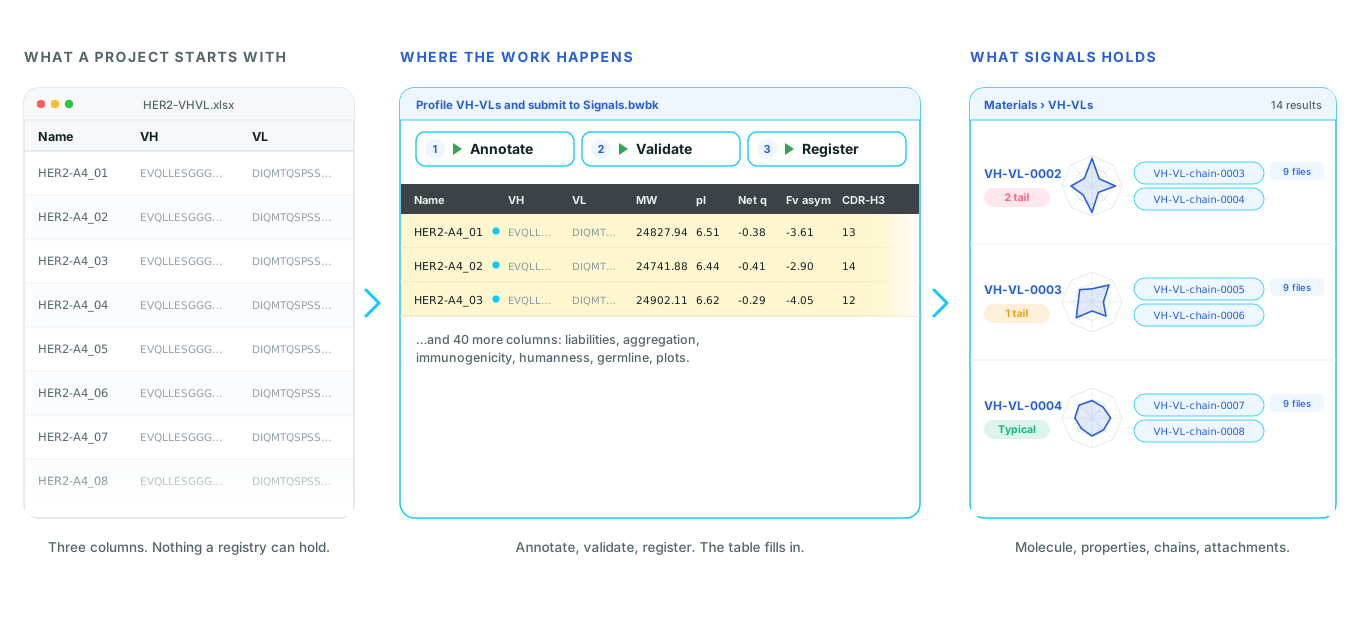
Interact with your data inside a spreadsheet-based workbook, powered by a growing list of tools, and analyse it in interactive plots and tables. The example below demonstrates deep developability profiling of antibody sequences.
From pasted sequences to a profiled table.
VH and VL sequences pasted straight from Excel are numbered ANARCI and folded into an Fv model ABodyBuilder2 , then run through developability Aggrescan3D SASA SURFMAP , immunogenicity MixMHC2pred and humanness BioPhi OASis Sapiens predictions, and benchmarked against clinical-stage antibodies SAbDab . The molecules are annotated with CDR and liability features, and the computed properties land back in the same table, with column names matching the Signals fields they will fill.
The example above uses a handful of these, and the list keeps growing:
Structure prediction and modelling
- Boltz-2
- Chai-1
- ABodyBuilder2
- NanoBodyBuilder2
- TCRBuilder2
Complexes with protein, ligand, DNA and RNA; antibody Fv from VH and VL, nanobodies and TCRs, with per-residue predicted error.
Design and mutation scanning
- RFdiffusion
- RFantibody
- ProteinMPNN
- ProteinMPNN-ddG
- AntiFold
- ESM-IF1
- ThermoMPNN
De novo backbones against a chosen antigen and epitope, sequence design on a fixed backbone, and exhaustive point-mutation scans for fitness and ΔΔG.
Developability and biophysics
- Antibody profiling
- Therapeutic nanobody profiler
- DeepSP
- DeepViscosity
- Aggrescan3D
- NetSolP
- MusiteDeep
- SEMA-3D
Aggregation, viscosity, solubility, phosphorylation sites and conformational B-cell epitopes.
Humanness and immunogenicity
- BioPhi
- OASis
- Sapiens
- MHCflurry
- MHCfovea
- MixMHC2pred
- TLimmuno2
- DeepImmuno
Humanness scoring and humanisation, MHC-I and MHC-II binding, and immunogenicity prediction.
Language models and small molecules
- AMPLIFY
- ADMET-AI
- GNINA
Protein language model likelihoods and embeddings, 49 ADMET endpoints from SMILES, and docking with CNN pose and affinity rescoring.
Sequence search and alignment
- BLAST
- HMMER
- MMseqs2
- DIAMOND
- CD-HIT
- Clustal Omega
- seqkit
Numbering and germlines
- ANARCI
- Immunum
- IgBLAST
- IMGT germline search
IMGT, Kabat, Chothia, Martin and Aho, with heavy, kappa and lambda chains detected automatically.
Repertoires and NGS
- OAS paired and unpaired
- SAbDab
- FASTQ to HMM counting
- Library mapping
- Sanger AB1
Display-library counting with pre and post selection, closest-member matching and profile HMM building.
Docking, structure and surfaces
- AutoDock Vina
- GNINA
- LightDock
- US-align
- Foldseek
- SURFMAP
- PyMOL
- SASA
Including a prebuilt antibody structure database and surface property mapping.
Simulation and cheminformatics
- GROMACS
- OpenMM
- APBS
- PDB2PQR
- PROPKA
- RDKit
- ProtParam
- Codon optimisation
Molecular dynamics on GPU, electrostatics, descriptors and properties from SMILES.