
Identify an antibody from its sequences
Sequences arrive without any of the things you need to know about them. Which domains each chain is made of, how the chains pair, whether this is a molecule the company already holds: all of it has to be worked out before the sequences are much use. Pasting them in settles all three.
Four chains and nothing else
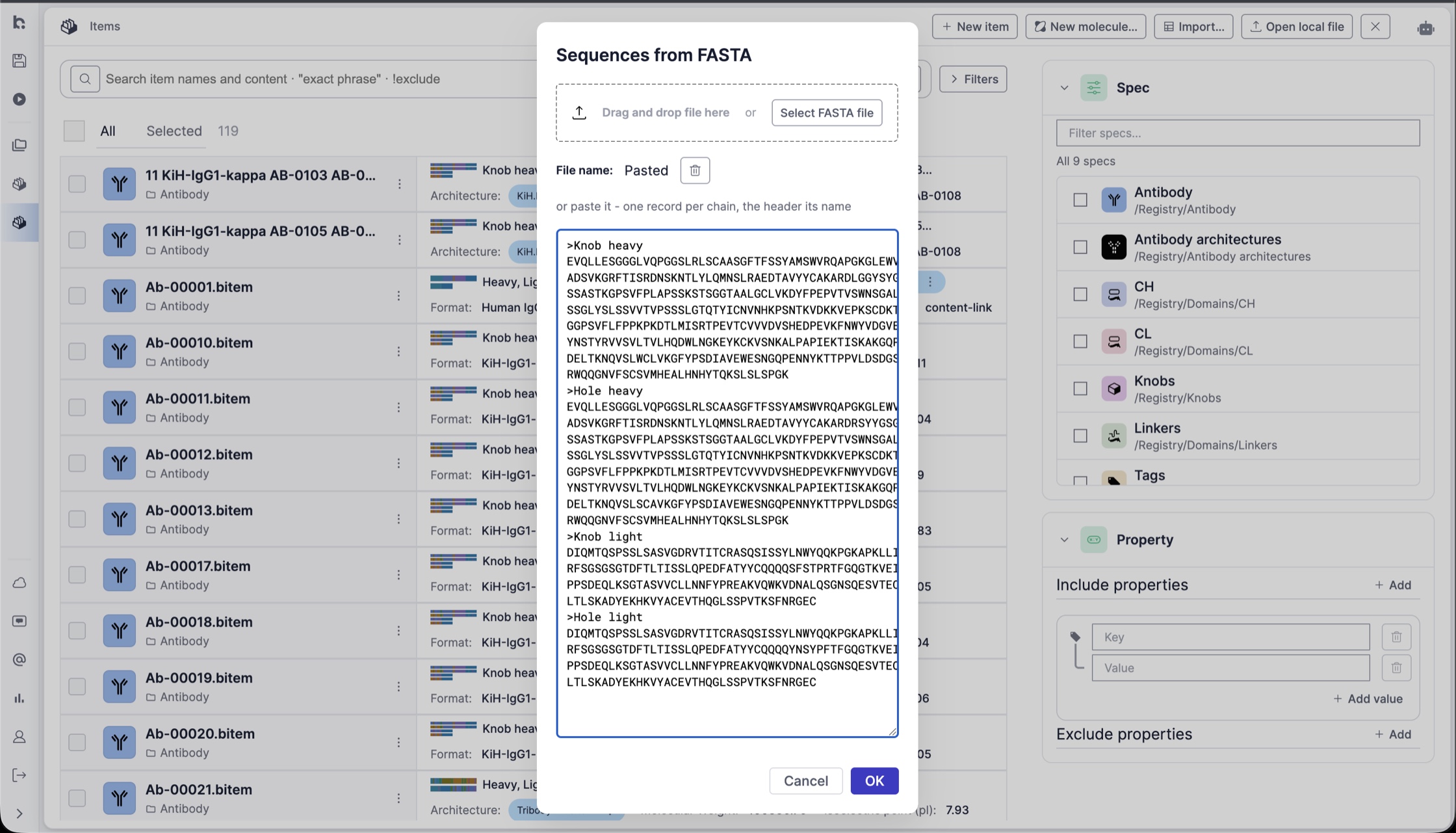
Four sequences arrive in a FASTA file, two heavy and two light. The headers carry whatever names the sender happened to use. There is no numbering, no annotation, and nothing to say which arm binds which target.
They go in as they are. Nothing is set up first and nothing is chosen from a list.
Every residue accounted for
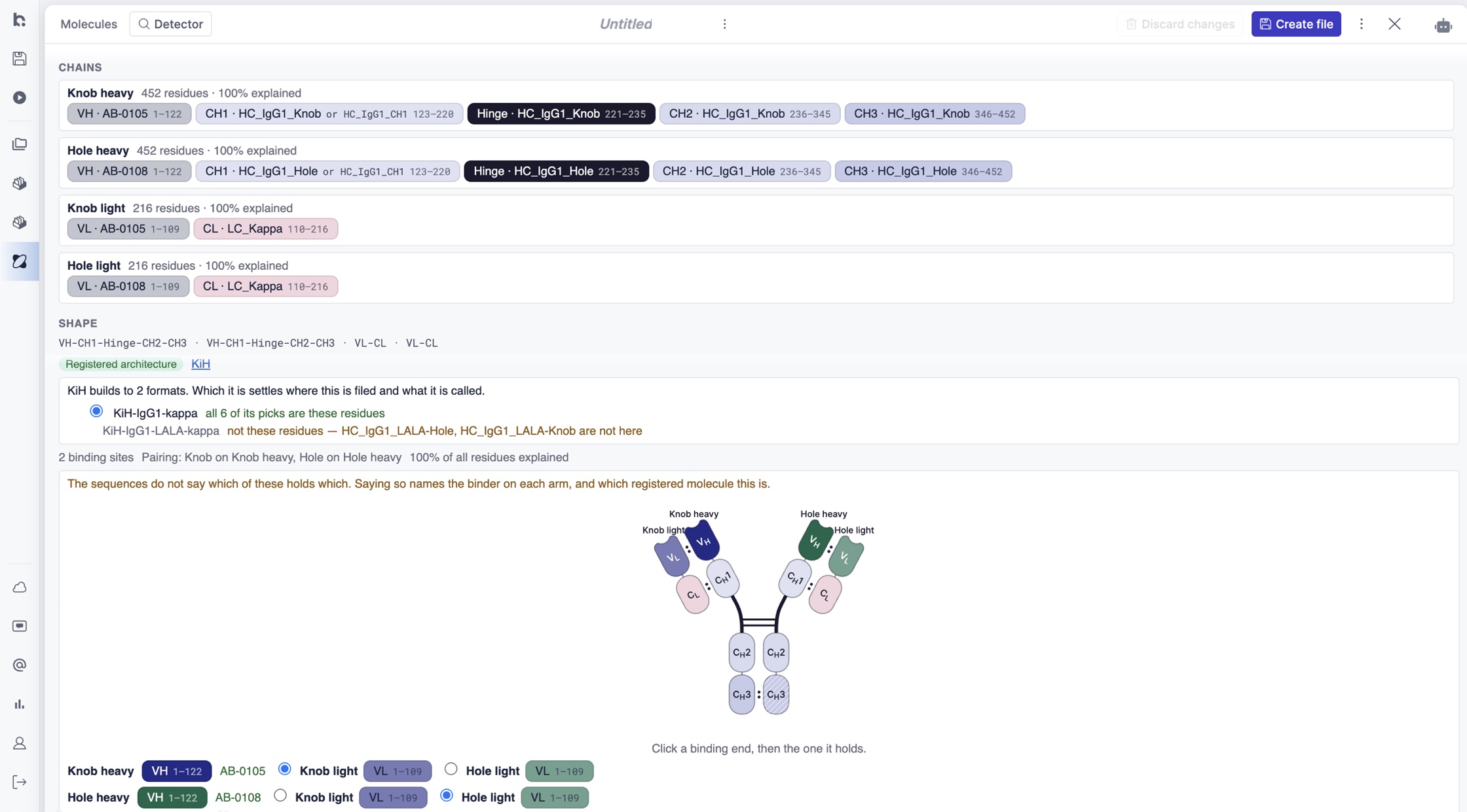
Each chain is read against the registered domains. All four come back complete: 452 residues in each heavy chain, 216 in each light, with nothing left unexplained.
Both variable domains are recognised, a different one on each arm. The constant regions are recognised in the same detail. One heavy chain carries the knob and the other the hole, and both light chains are kappa. Every match shows the stretch of residues it covers, so it is clear where one domain ends and the next begins.
Put together, the four chains make a knob-into-hole IgG1, and that is a shape the company has described before.
Which molecule it is
Recognising the shape is not the same as recognising the molecule. Two registered formats are built this way. They differ only in the constant region: one carries the LALA substitutions that silence effector function, the other does not. Those substitutions are not in these sequences, so this is the plain IgG1 kappa version, and that is what decides its name and where it belongs.
This is the part that is easy to get wrong by hand. A search against a sequence library will tell you the arms look familiar. It will not tell you that the molecule in front of you is the wild-type variant rather than the effector-silenced one, and those two are not interchangeable.
And when it is new
Sequences that match nothing registered are read the same way. The domains are named, the ranges fixed and the arrangement worked out. What does not come back is a match, because there is nothing yet to match.
One question is left open on purpose. Sequence alone cannot say which light chain pairs with which heavy arm, so it is asked rather than guessed. Once it is answered, each arm has a named binder and the record is finished. A molecule registered this way is annotated before it goes in, not afterwards.